
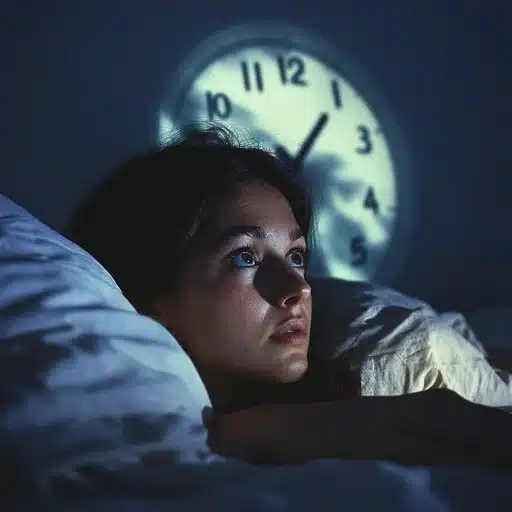
Anxiety and insomnia are not just correlated — they are mechanistically intertwined in a self-reinforcing cycle that can be genuinely difficult to escape. Understanding exactly how and why anxiety disrupts sleep is the first step toward breaking the loop.
This article explains the biology of the anxiety-insomnia cycle and, more importantly, gives you practical evidence-based strategies for disrupting it.
😰 The Biology of Why Anxiety Keeps You Awake
🔹 The Threat Detection System
Your brain has a threat detection system centered on the amygdala and the hypothalamus. When this system detects danger — real or perceived — it activates the HPA (hypothalamic-pituitary-adrenal) axis and the sympathetic nervous system, triggering the release of cortisol and adrenaline.
In people with anxiety, this threat detection system is chronically overactive. It generates alerts about future worries, social situations, health concerns, financial stress — threats that are psychological rather than physical, but which trigger the same physiological response as a genuine emergency.
Sleep requires the opposite of this state. To fall asleep, you need to shift from sympathetic (fight-or-flight) activation to parasympathetic (rest-and-digest) dominance. When your threat system is firing, this shift becomes very difficult.
🔬 Cortisol Timing Problems
In a healthy circadian rhythm, cortisol peaks about 30-45 minutes after waking and gradually declines through the day, reaching its lowest point in the hours around midnight. This declining cortisol is part of what makes you feel sleepy in the evening.
In people with anxiety, this pattern is disrupted. Cortisol may spike in the late evening — exactly when it should be low. This creates the maddening experience of feeling exhausted but unable to sleep: your body is tired, but your cortisol is telling your brain it is daytime and danger is present.
🔹 Hyperarousal and Cognitive Rumination
Anxiety creates cognitive hyperarousal — a state of heightened mental activity, rapid thought, and difficulty disengaging from worry. Research using EEG shows that people with anxiety and insomnia have significantly more high-frequency brain activity (beta waves) at sleep onset and during the night than good sleepers.
This explains the racing thoughts phenomenon. The brain simply cannot make the transition from active processing to the slower brain states needed for sleep.
😴 How Poor Sleep Worsens Anxiety
Here is where the cycle closes. After a poor night of sleep:
- ✅ The amygdala becomes 60% more reactive to negative stimuli (fMRI research from UC Berkeley)
- 💡 Prefrontal cortex activity — which modulates the amygdala and enables rational thinking — is reduced
- 🔹 Cortisol levels the next day are higher
- 🌿 Emotional regulation capacity decreases
- ⚡ Catastrophic thinking increases
The result: anxiety is worse after bad sleep, which makes sleep harder that night, which worsens anxiety the next day. This is a genuine neurobiological loop, not a personal failing.
🔬 Breaking the Cycle: Evidence-Based Strategies
🌙 1. Cognitive Behavioral Therapy for Insomnia (CBT-I)
CBT-I is the gold-standard treatment for chronic insomnia, with large randomized trials showing it outperforms sleep medication even in the short term — and continues working after treatment ends, unlike medication.
Its core components include sleep restriction therapy (temporarily limiting time in bed to build sleep drive), stimulus control (re-associating the bed with sleep rather than wakefulness and worry), and cognitive restructuring (changing dysfunctional beliefs about sleep that perpetuate anxiety).
Digital CBT-I programs like Sleepio and Somryst are now available and have been validated in clinical trials for people who cannot access in-person therapy.
🔹 2. Break the Worry Loop Before Bed
Scheduled worry time is a counterintuitive but evidence-backed technique. Set aside 15-20 minutes in the late afternoon — not close to bedtime — specifically to write down everything you are worried about and any action steps you can take. Research shows this reduces intrusive thoughts at bedtime by giving the worry-processing part of the brain a sanctioned outlet earlier in the day.
If worried thoughts arise at bedtime, write them on a notepad by the bed with the instruction “I will deal with this tomorrow.” This signals to the brain that the thought has been captured and does not need to be held in active processing.
🔹 3. Physiological Sigh
The fastest way to shift from sympathetic to parasympathetic activation is the double inhale followed by a long exhale — the physiological sigh. Take a full breath in through the nose, then a second short sniff to fully inflate the lungs, then a slow, complete exhale through the mouth.
Research from Stanford’s Huberman Lab found this was the most effective single breathing technique for rapidly reducing anxiety. Doing 5-10 of these at bedtime significantly reduces physiological arousal.
🔹 4. Body Temperature Manipulation
Sleep onset is triggered by a drop in core body temperature of about 1-2 degrees. A warm bath or shower 1-2 hours before bed paradoxically accelerates this cooling — the warm water draws blood to the surface of the skin, and when you get out, heat dissipates rapidly, dropping core temperature faster than it would naturally.
A 2019 meta-analysis found that warm bathing 1-2 hours before bedtime improved sleep quality, sleep efficiency, and reduced sleep onset latency.
🔹 5. Consistent Wake Time
The single most powerful anchor for the circadian system is a consistent wake time — every day, including weekends. Variable wake times destabilize the circadian rhythm, which makes the cortisol curve less predictable and worsens both anxiety and sleep quality.
Sleep pressure — the adenosine buildup that creates sleepiness — is driven by time awake. The longer and more consistently you stay awake from the same time each morning, the stronger and more reliable your sleep pressure will be at night.
☀️ 6. Morning Light Exposure
Getting bright light exposure within the first 30-60 minutes of waking sets the circadian clock and — crucially — determines when you will feel sleepy that evening. It also produces a cortisol pulse that helps normalize the diurnal cortisol curve, making evening cortisol lower and sleep onset easier.
10-30 minutes of outdoor light (even on overcast days) is the recommendation. The intensity of outdoor light — even on a cloudy day — is far greater than indoor lighting.
🎯 The Bottom Line
The anxiety-insomnia cycle is real, biological, and self-reinforcing — but it is also breakable. The strategies above — particularly CBT-I techniques, pre-bed nervous system downregulation, and circadian anchoring — have the strongest evidence base. They require some consistency to work, but unlike medication, they address root causes rather than masking symptoms. Many people find that improving sleep quality is the single most effective thing they can do for their anxiety, precisely because sleep is so foundational to emotional regulation.
Related Resources: Discover more sleep-focused strategies in our Sleep & Recovery guide.
❓ Frequently Asked Questions
What is the anxiety-insomnia cycle?
The anxiety-insomnia cycle is a self-reinforcing loop: anxiety makes it harder to fall and stay asleep, and sleep deprivation increases anxiety the next day. Poor sleep elevates cortisol, impairs prefrontal cortex regulation, increases amygdala reactivity, and depletes the emotional resources needed to manage anxiety.
How do I break the anxiety-insomnia cycle?
Breaking the cycle requires addressing both sides simultaneously. For sleep: strict sleep schedule, cool dark room, no screens before bed, and CBT-I techniques. For anxiety: breathwork, nervous system regulation practices, and addressing root causes. Magnesium glycinate can support both. CBT-I is the most evidence-supported single intervention.
Does treating anxiety improve sleep?
Yes. When anxiety is effectively treated — through CBT, lifestyle modification, or medication — sleep quality typically improves significantly alongside it. The two conditions are so intertwined that meaningful progress on anxiety almost always produces parallel sleep improvements.
Can poor sleep cause anxiety disorder?
Chronic sleep deprivation can precipitate anxiety disorders in vulnerable individuals and maintains them once established. Sleep deprivation increases amygdala reactivity by up to 60%, disconnects the amygdala from prefrontal regulation, and elevates baseline cortisol — all of which prime the brain for anxiety.
What is CBT-I and how does it help the anxiety-insomnia cycle?
CBT-I (Cognitive Behavioral Therapy for Insomnia) addresses both the cognitive (worry about sleep) and behavioral (irregular schedules, excessive time in bed) patterns that perpetuate insomnia. It is equally effective for anxiety-related insomnia and outperforms sleep medications in long-term outcomes, with no side effects.
Looking for something specific?
Search all our science-backed articles on natural anxiety relief.