⚠️ Medical Disclaimer: This article is for educational purposes only and does not constitute medical advice. The Oura Ring is a consumer wellness tracking device, not an FDA-cleared medical device (with the exception of its temperature-based Natural Cycles integration). It is not intended to diagnose, treat, cure, or prevent any medical condition. Always consult a qualified healthcare provider about anxiety, depression, or any health concern.
The Oura Ring 4 is the most scientifically validated consumer sleep tracker on the market. With 5.5 million rings sold, research partnerships with Harvard, UCSF, Stanford, and the National University of Singapore, and independent validation showing 96% sleep staging accuracy against polysomnography (PSG) — the gold standard of sleep science — it occupies a category of its own among wearable wellness devices.
But there’s an important distinction to make upfront: the Oura Ring does not treat anxiety. It tracks it, quantifies the physiological markers associated with it, and helps you understand it. That’s a fundamentally different value proposition from every other device in this review series — and for many people, it’s exactly what they need.
💍 What Is the Oura Ring? How It Works
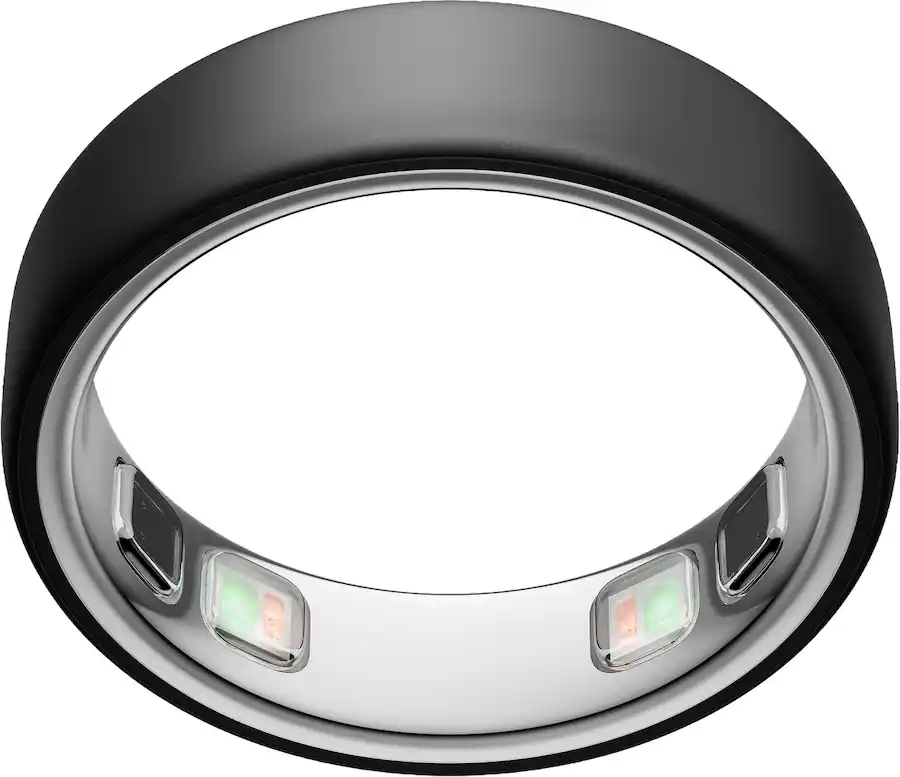
The Oura Ring Gen 4 is a titanium smart ring worn on the finger that continuously measures your physiology using an 18-path multi-wavelength photoplethysmography (PPG) system, along with skin temperature, accelerometer, and gyroscope sensors. All data syncs to the Oura app, which translates raw biometrics into three core daily scores: Sleep Score, Readiness Score, and Activity Score — plus dedicated dashboards for Stress and Resilience.
The Gen 4’s major hardware advance over its predecessor is Smart Sensing 2.0 — a redesigned sensor array with 18 infrared LED pathways that adapts to ring rotation during sleep, solving the core accuracy problem of earlier generations where a rotated ring would lose sensor contact.
📋 Oura Ring 4 Specs at a Glance
| Sensors | 18-path PPG (red + infrared LEDs), skin temperature, accelerometer, gyroscope |
| Key Metrics | Sleep stages, HRV (RMSSD), resting heart rate, SpO2, skin temp, steps, calories, daytime stress, resilience, cardiovascular age, VO2 max estimate |
| Sleep Accuracy | 96% vs. polysomnography (Journal of Sleep Research, 2025) |
| Battery Life | 8 days |
| Material | Titanium (also available in zirconia ceramic as of October 2025) |
| Water Resistance | 100m |
| Price | $349–$499 (depending on finish) |
| Subscription | $5.99/month or $69.99/year (required for full feature access) |
| FDA Status | Not FDA-cleared as a medical device (temperature used in FDA-cleared Natural Cycles contraceptive integration) |
| App | iOS + Android, 12 languages |
😟 How Oura Ring Relates to Anxiety: 4 Key Features
❤️ 1. HRV Tracking — Your Nervous System’s Daily Report Card
Heart Rate Variability (HRV) is one of the most clinically meaningful metrics for anxiety and autonomic nervous system health. Lower HRV is consistently associated with higher anxiety, chronic stress, and poor recovery. Oura’s nighttime HRV measurement (RMSSD) has been validated to within ±5ms of the Polar H10 chest strap — the reference standard for HRV research. This means you’re getting clinically meaningful data, not a vague wellness estimate. Tracking your HRV trend over weeks and months gives you an objective window into whether your anxiety management strategies are actually working — something almost impossible to assess subjectively.
😴 2. Sleep Tracking — Precision Data on Anxiety’s Biggest Trigger
Poor sleep and anxiety are deeply bidirectional — each makes the other worse. Oura’s sleep staging (light, deep, REM, awake) has been independently validated at 96% accuracy against PSG in the Journal of Sleep Research (2025), making it the most accurate consumer sleep tracker available. For people with anxiety, understanding your actual sleep architecture — not just total hours, but the quality and timing of REM and deep sleep — is actionable intelligence. The Readiness Score synthesizes HRV, resting heart rate, body temperature, and sleep quality into a single daily number that tells you how recovered you actually are before the day begins.
🧘 3. Daytime Stress Monitoring — Catching Anxiety Before It Catches You
Added in 2024, Oura’s Daytime Stress feature continuously tracks your physiological stress load using HRV, heart rate, and temperature throughout the day. The app displays a stress chart that distinguishes between stress states and recovery windows — giving you a real-time picture of your nervous system’s burden. The key insight is that the ring can detect physiological stress before you consciously register it, which is particularly valuable for people with anxiety who are often poor at gauging their own stress levels. Research using Oura data in police officers found that wearable-measured HRV could predict subsequent self-reported stress outcomes — evidence that the physiological signals the ring captures are meaningfully linked to experienced anxiety.
🛡️ 4. Resilience Score — Tracking Your Capacity to Handle Stress
Oura’s Resilience feature measures how well your body is balancing stress and recovery over a rolling two-week window, drawing on nighttime recovery metrics, daytime stress levels, and activity balance. For people managing chronic anxiety, this is arguably more useful than any single-day snapshot — resilience declines gradually before burnout, and seeing that trend early creates an opportunity to intervene. The feature was developed with Oura’s internal science team and validated internally before release.
🔬 The Research Behind Oura
Oura’s evidence base is categorically different from every other device in this series. The ring has been used as the primary data-collection instrument in studies at Harvard Medical School, Brigham and Women’s Hospital, UCSF, Stanford, Duke University, and the National University of Singapore (which found Oura to be the most accurate consumer wearable for sleep tracking). Publications appear in peer-reviewed journals including JMIR, Sensors, Sleep Medicine, and the Journal of Sleep Research.
One particularly relevant study used Oura Ring data to track depression, anxiety, and stress during the COVID-19 pandemic, finding significant correlations between Oura’s physiological metrics and self-reported mental health outcomes. Multiple studies using Oura HRV data in real-world populations have found associations between HRV trends and stress, anxiety, and burnout — validating the ring as a meaningful tool for monitoring mental health–adjacent physiology in daily life.
The critical distinction: this research validates Oura as a measurement tool, not a treatment device. The ring tells you what’s happening in your nervous system — it doesn’t change it.
⚖️ Oura Ring vs. Other Devices in This Series
| Device | Primary Function | FDA Status | Evidence Level | Price |
|---|---|---|---|---|
| Flow FL-100 | Treats depression | FDA Approved (Rx) | Nature Medicine RCT | $500–$800 |
| Alpha-Stim | Reduces anxiety/pain | FDA Cleared | 100+ studies, Lancet RCT | $795–$895 |
| Apollo Neuro | Calms nervous system | Not cleared | Multiple RCTs | $349 |
| Oura Ring 4 | Tracks physiology | Not cleared (medical) | Extensive — but for measurement, not treatment | $349–$499 + subscription |
| Hapbee | Mood signaling | Not cleared | No independent RCTs | $249 + subscription |
✅ Who Oura Ring Is a Good Fit For
- People who want objective data on how anxiety, sleep, and stress are affecting their body
- Biohackers and self-quantifiers who make decisions based on physiological trends
- Anyone using other treatments (therapy, medication, neurostimulation devices) who wants to track whether they’re actually working
- People with anxiety who suspect poor sleep is a major driver — the sleep data is unmatched
- Women tracking cycles, fertility, or hormonal influences on anxiety and mood
- Those who want a discreet wearable with no screen, no notifications, and 8-day battery life
❌ Who Should Look Elsewhere
- People looking for a device that actively reduces anxiety — Oura doesn’t intervene, it observes. For active treatment, see Alpha-Stim, Fisher Wallace, or Apollo Neuro
- Those uncomfortable with subscription costs on top of hardware — without the subscription, most of the anxiety-relevant features (HRV, Stress, Resilience) are locked
- Anyone prone to health anxiety — continuous biometric tracking can worsen anxiety in people who obsessively monitor their data. Know yourself here
- Budget-conscious buyers — at $349–$499 plus subscription, it’s among the pricier options in this series
📊 StopAnxiety.org Rating
Rating: 4.8 / 5
The Oura Ring 4 earns one of the highest ratings in this series — not because it treats anxiety, but because it does what it does better than any other consumer device on the market. The sleep tracking accuracy is best-in-class, the HRV and stress data are clinically meaningful, and the Resilience feature gives people with chronic anxiety a genuinely useful longitudinal view of their nervous system health. The subscription model and the risk of data-driven health anxiety are real caveats. But for anyone serious about understanding the physiological dimension of their anxiety — and tracking whether their interventions are actually working — the Oura Ring is the most powerful measurement tool available without a prescription.
📚 Also on StopAnxiety.org:
- Alpha-Stim Review — FDA-Cleared CES for Anxiety and Insomnia
- Apollo Neuro Review — Does This Anxiety Wearable Actually Work?
- Flow Neuroscience Review — The First FDA-Approved At-Home Brain Stimulation Device
- NeoRhythm Review — PEMF Brainwave Entrainment for Anxiety and Sleep
- Browse All Tools & Devices Reviews →
Medical Disclaimer: This article is for educational purposes only and does not constitute medical advice. The Oura Ring is a consumer wellness tracking device and is not FDA-cleared as a medical device for anxiety or any other condition. Always consult a qualified healthcare provider about anxiety, sleep disorders, or any health concern. Individual results vary.
Looking for something specific?
Search all our science-backed articles on natural anxiety relief.